
The vanity plays a central role in how a bathroom remodel comes together. It influences the layout, storage, cleaning, plumbing, and the overall feel of the space. Whether you are updating a primary bathroom, kids bathroom, hall bathroom, or powder room, understanding the difference between a standard vanity and a floating vanity helps you choose the style that supports your bathroom design goals and the way the room needs to function day to day.
In practice, almost every project we design uses one of two vanity types:
- A standard vanity, which sits on the floor and is attached to the wall
- A floating vanity, which is mounted to the wall and does not touch the floor
Both can look beautiful and both can be excellent choices. The right one depends on your layout, how the bathroom is used, and the look you want. Our designers’ job is to walk you through the tradeoffs and help you choose what fits your space and your goals, not just what is trendy on Instagram.

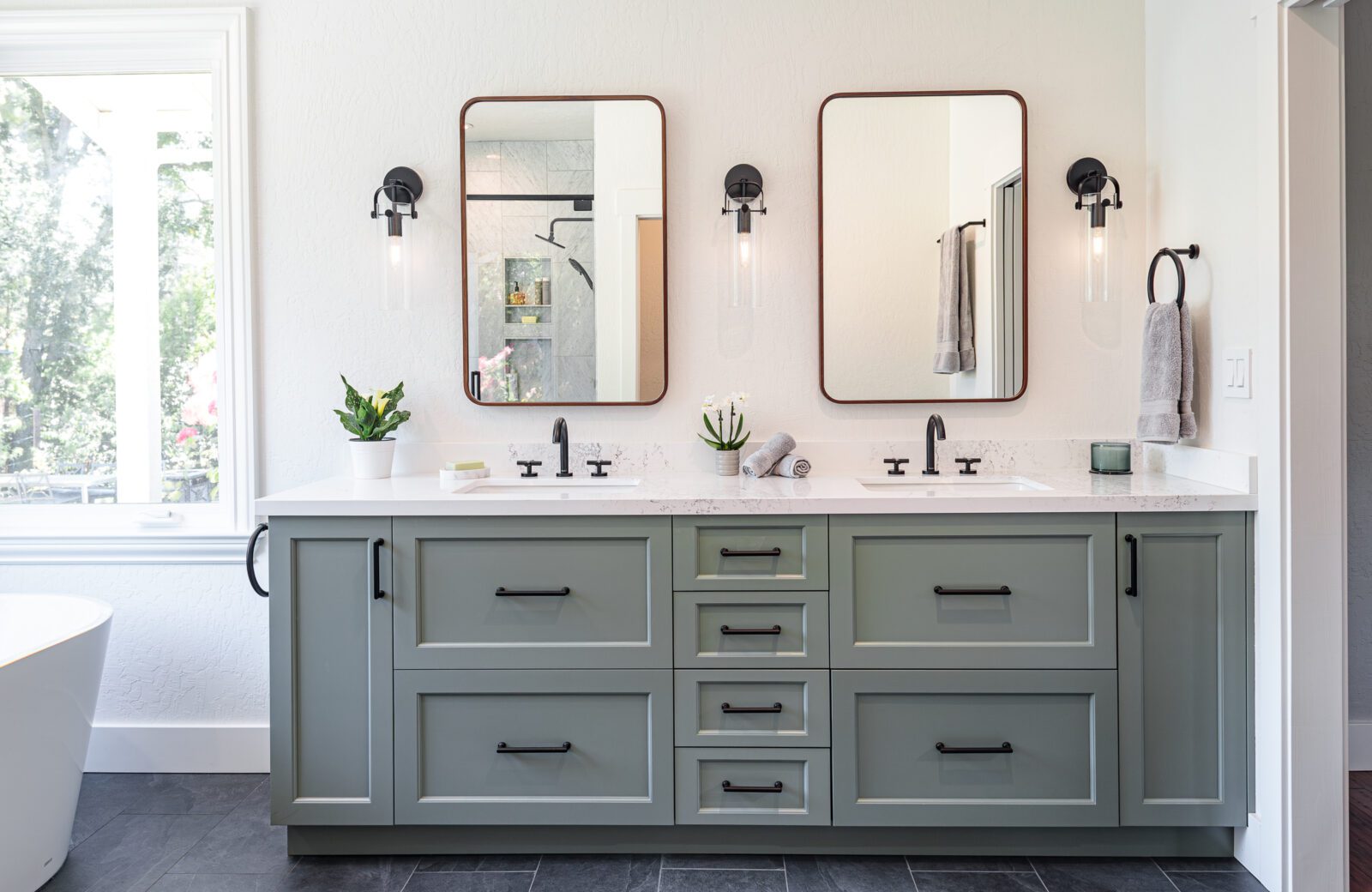
What’s a Standard Bathroom Vanity?
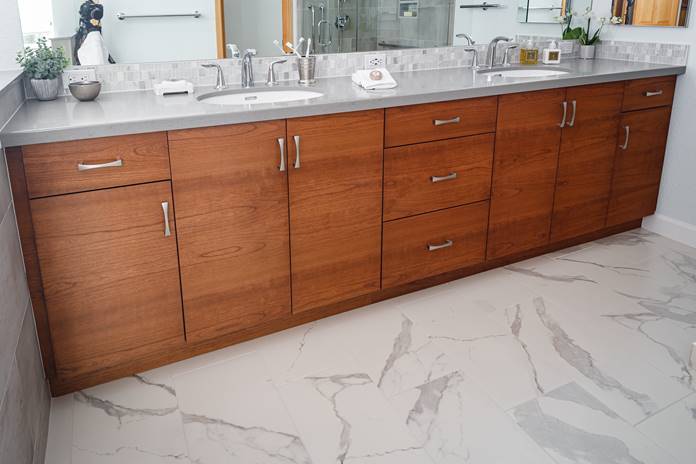
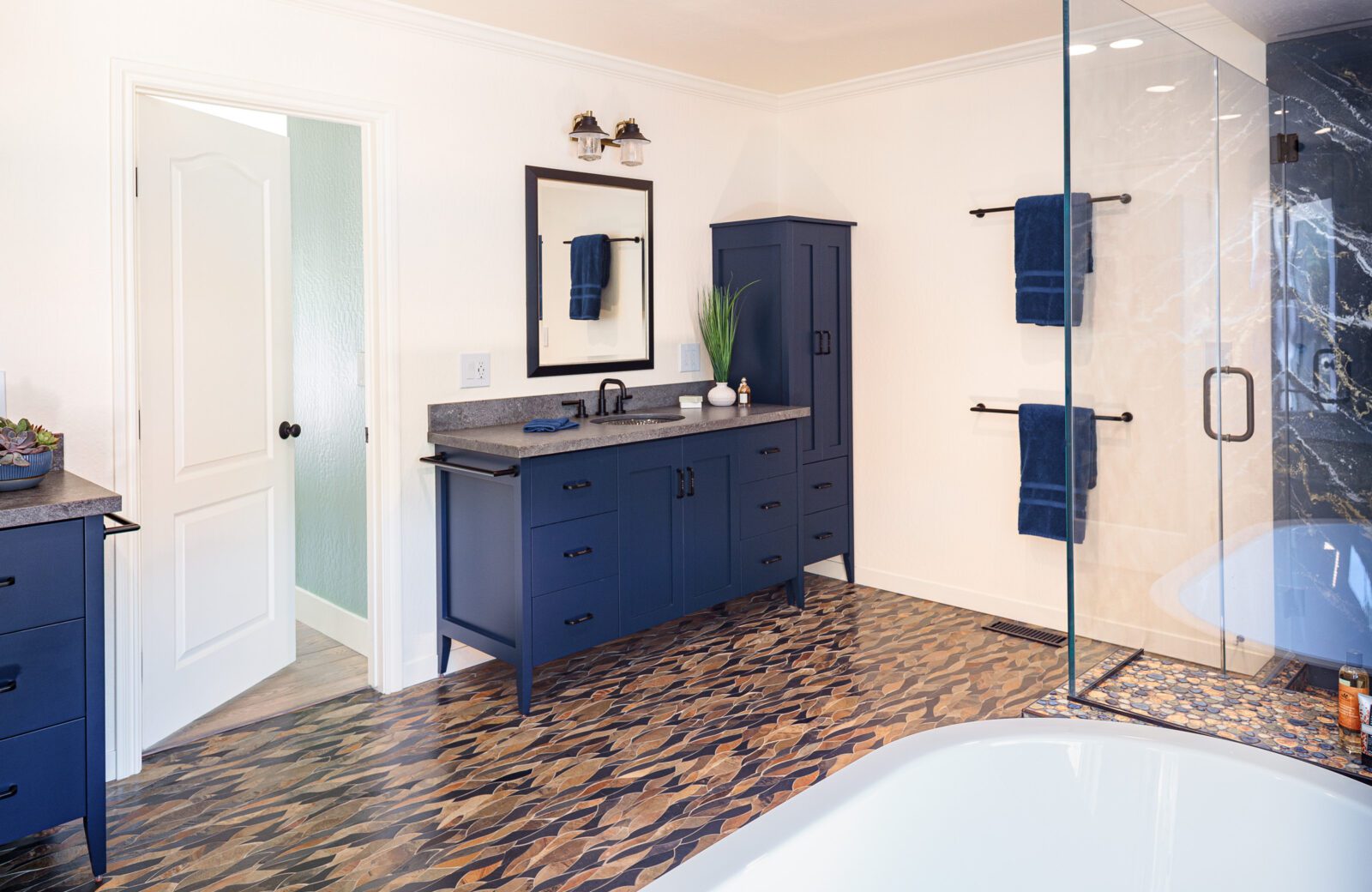
A standard bathroom vanity is any vanity that sits on the floor and is secured to the wall. It is the most common type used in bathroom remodels. Most standard vanities are built like kitchen cabinets with a toe kick and straightforward box construction. A smaller percentage are furniture-style pieces with legs or decorative details, but they still attach to the wall for stability and fall under the same category during installation.
A standard bathroom vanity typically:
- Sits on the floor.
- Attaches to the wall for safety.
- May have legs or a full base with a toe kick.
- Comes in pre-made, semi-custom, and custom versions.
- Can be made from MDF, plywood, hardwood, or a combination.
- Has doors, drawers, or a combination of the two.
What’s a Floating Bathroom Vanity?
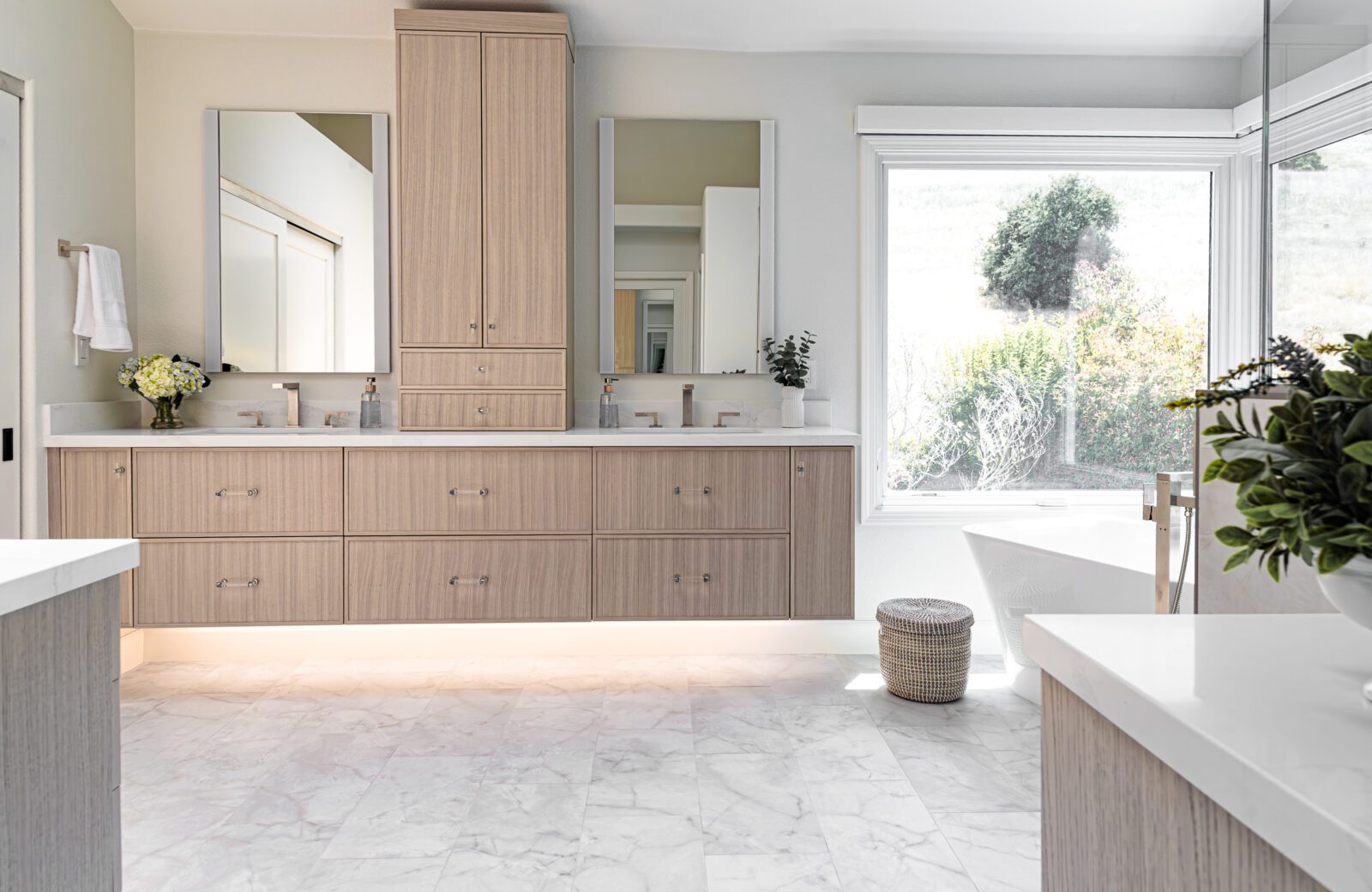
A floating bathroom vanity is mounted directly to the wall and does not touch the floor. All of the weight from the cabinet, sink, and countertop is carried by the wall framing, along with any blocking or metal support added during installation. Because the wall carries the load instead of the floor, floating vanities are typically built with a stronger back panel and a more rigid cabinet box than many standard vanities.
A floating vanity typically:
- Attaches fully to the wall.
- Leaves the floor exposed beneath it.
- Has drawers that are designed around the plumbing.
- Is made from plywood with a wood or laminate veneer because plywood is strong.
- Allows more flexibility in choosing the installation height.
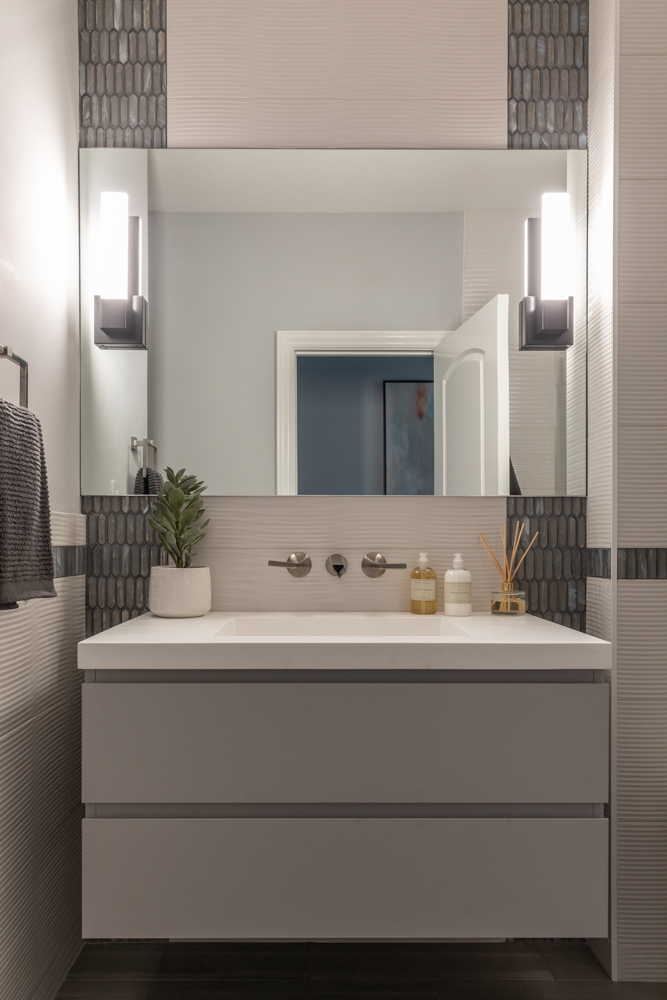
Floating vanities create a clean, modern look and can make a bathroom feel more open.
Choosing the Right Bathroom Vanity in Your Remodel Means You Need to Set Goals for the Space
Your decision begins with understanding what you want the space to accomplish. Common goals sound like:
- I want the bathroom to feel calm and spa-like.
- This is the kids’ bathroom, and it needs to handle real wear and tear.
- The house has a specific architectural style, and the bathroom should follow it.
- I want a vanity that is easy to clean around.
From there, it’s important to consider the room’s size and shape, where the plumbing is located, how the bathroom is used day to day, and how the home’s style should guide your remodel.
Once those pieces are understood, the vanity choice usually becomes clear.
Drawings and 3D renderings are important for seeing how each vanity option fits the space, identifying trade-offs, and determining which direction best supports your remodel goals.
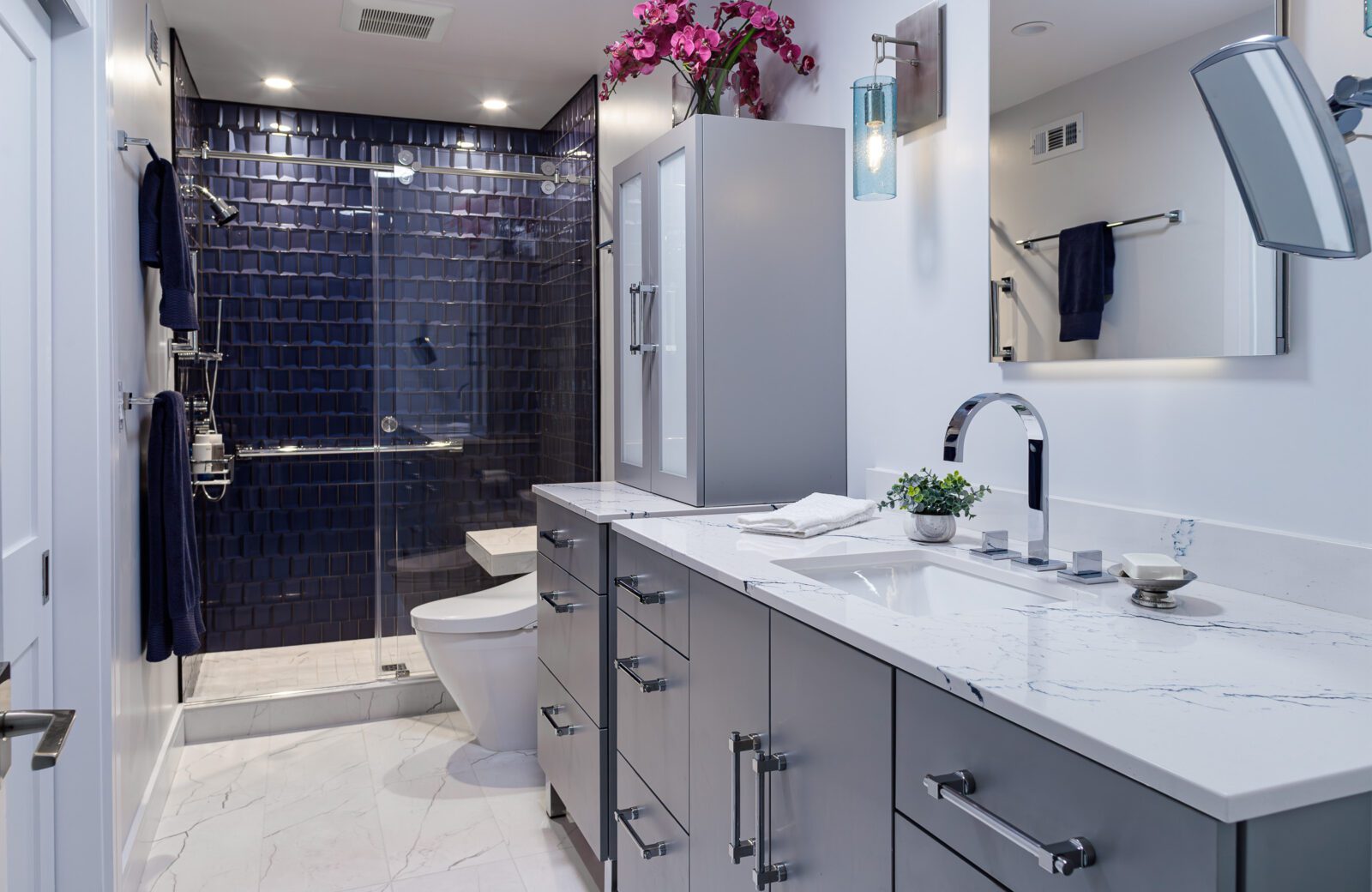
Standard Bathroom Vanities in a Bathroom Remodel: Where They Shine and Where They Struggle
Where Standard Bathroom Vanities Shine
Strong visual presence in many bathroom designs
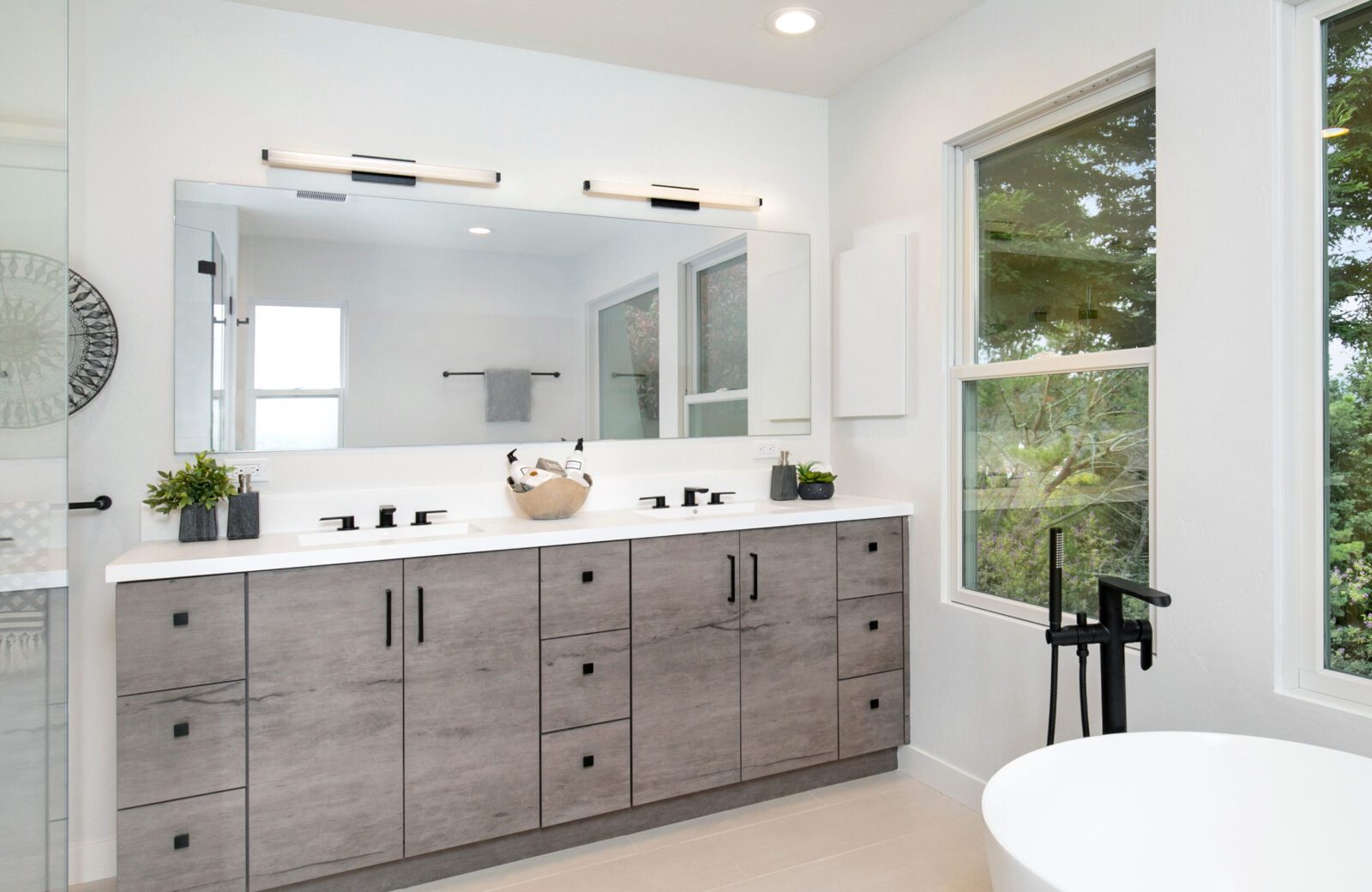
A standard bathroom vanity suits a wide range of bathroom styles. It works especially well in traditional bathroom designs, craftsman homes, and primary bathroom remodels where a heavier visual element helps balance the space.
Simpler installation during a bathroom renovation
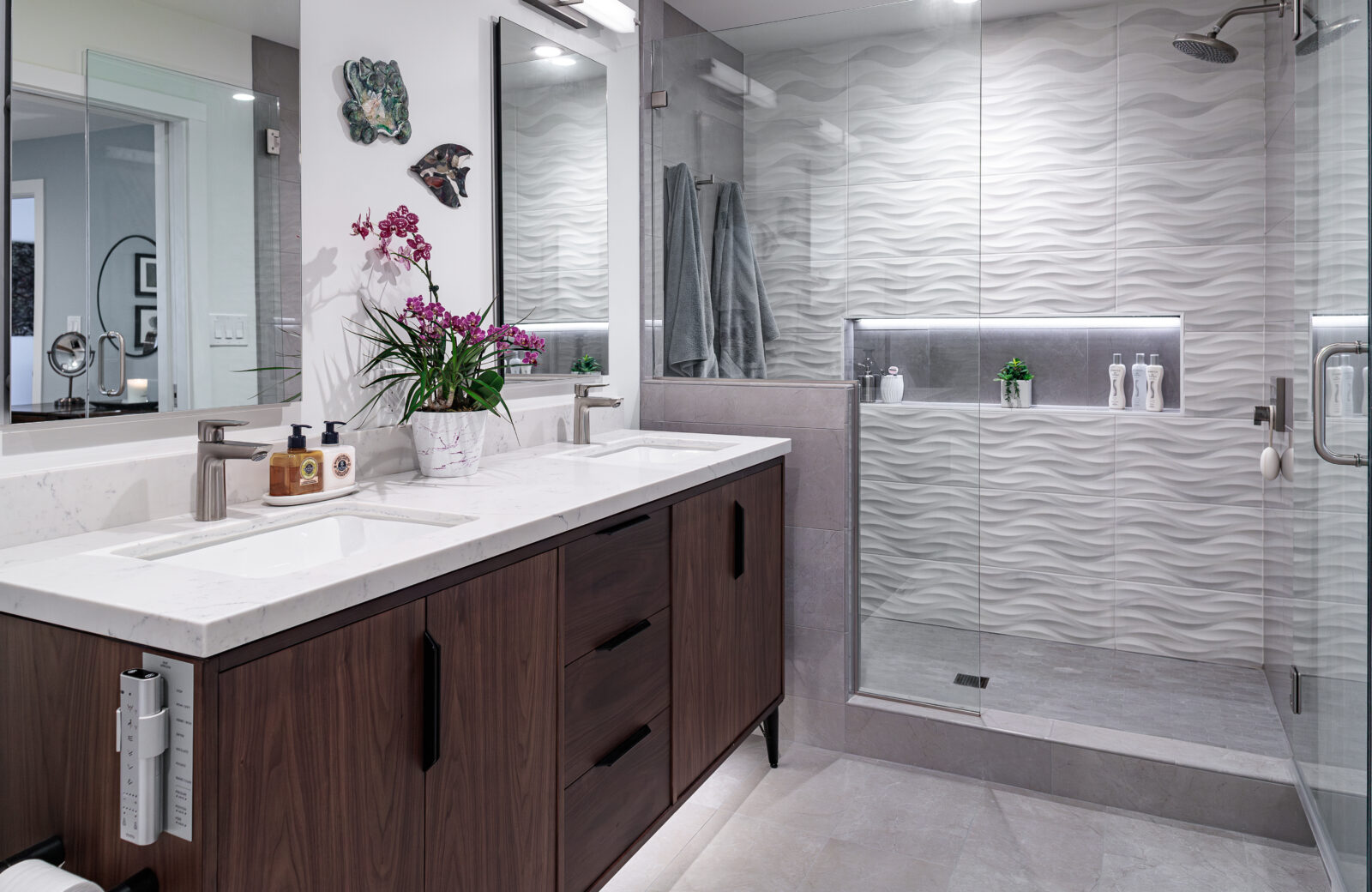
During a bathroom remodel, a standard vanity is usually the easier installation option. It sits on the floor, attaches to the wall for stability, and gives the plumber more flexibility with trap height and pipe placement because everything stays hidden inside the cabinet. When you replace one standard vanity with another of similar size, the new cabinet typically covers the same footprint, so the existing tile and plumbing do not need to be disturbed.
This is very different from installing a floating vanity. A floating vanity requires the plumbing to be high enough so that it sits fully inside the cabinet. If the supply lines or drain are too low, they will be visible below the floating vanity, defeating the purpose of choosing a wall-mounted design. If you are replacing a standard vanity, the existing plumbing height might make a floating vanity impossible without rerouting pipes, which adds cost and wall work.
Ideal for bathrooms with floor plumbing
Many hall bathrooms and older homes have plumbing lines that come up through the floor. Standard vanities typically accommodate this, avoiding the extra work of moving plumbing into the wall.
Where Standard Bathroom Vanities Struggle
Storage space that looks generous in a bathroom remodel but is often inefficient
A standard bathroom vanity goes to the floor, offering the largest overall cabinet volume in a bathroom remodel. The challenge is that most off-the-shelf standard vanities are built with cabinet doors instead of drawers. This creates a single open space under the sink that does not function well for daily bathroom storage. In many primary bathroom remodels, hall bathrooms, and kids bathrooms, the same issues come up:
- The sink is usually in the middle of the cabinet with the trap dropping down from the middle of the sink impeding practical storage.
- The open space on each side of the plumbing is inefficient because things need to be stacked.
- Items get stacked in piles and pushed to the back.
- The full depth and height are hard to use without built-in or aftermarket organization.
Homeowners often add aftermarket organizers during a bathroom renovation to improve the storage, and these can help. The results are mixed because the cabinet was not designed around the plumbing, so many off-the-shelf organizers leave awkward gaps or fail to use the space as efficiently as you might need.
Custom standard vanities address this by designing drawers or pullouts around the plumbing from the start. This makes the storage far more functional in a bathroom remodel. The tradeoff is cost, since custom cabinetry adds to the overall budget.
Harder to clean and more prone to wear during everyday bathroom use
Standard bathroom vanities sit directly on the floor, which means the base of the cabinet takes more contact during daily cleaning. A toe kick is not necessarily difficult to reach with a mop, but it does get bumped repeatedly by mops, brooms, and vacuums. Over time, that regular contact can wear down the finish, especially in busy primary bathrooms or kids’ bathrooms where cleaning and bumping happen more often.
Furniture-style legs create a different challenge. They leave small gaps around and under the vanity that are harder to clean thoroughly, and those tight spaces tend to collect dust.
Can make small bathrooms feel tighter
In compact bathrooms, such as a hall bathroom, kids’ bathroom, or a powder room remodel, a full-height cabinet blocks more of the floor tile from view. This reduces visual openness compared to a floating vanity, which helps a small bathroom feel larger.
When a Standard Vanity Fits the Bathroom Remodel
A standard vanity is often the best choice when:
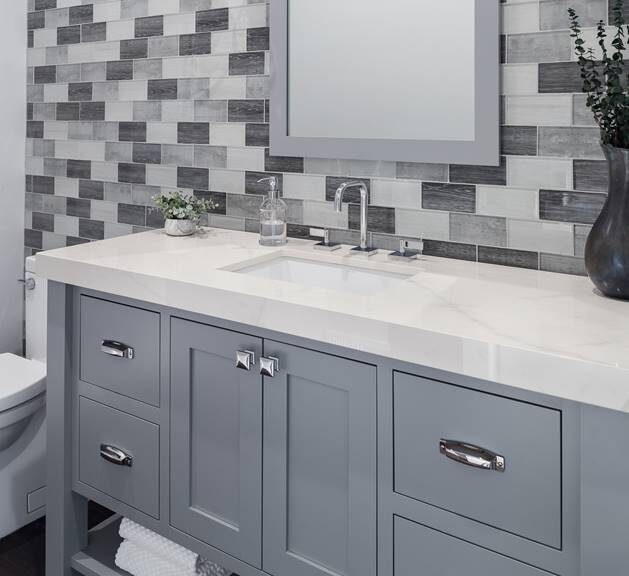
- The home leans traditional, craftsman, or transitional.
- The bathroom remodel needs to work with the existing plumbing.
- The primary bathroom is large enough to absorb the visual weight.
- The goal is a warm, classic bathroom design instead of a minimal, clean-lined, contemporary look
Standard vanities remain a strong choice in many primary and kids’ bathrooms because they feel familiar, work with many architectural styles, integrate easily into most layouts, and may help avoid the need to relocate plumbing.
Floating Bathroom Vanities in a Bathroom Remodel: Where They Shine and Where They Struggle
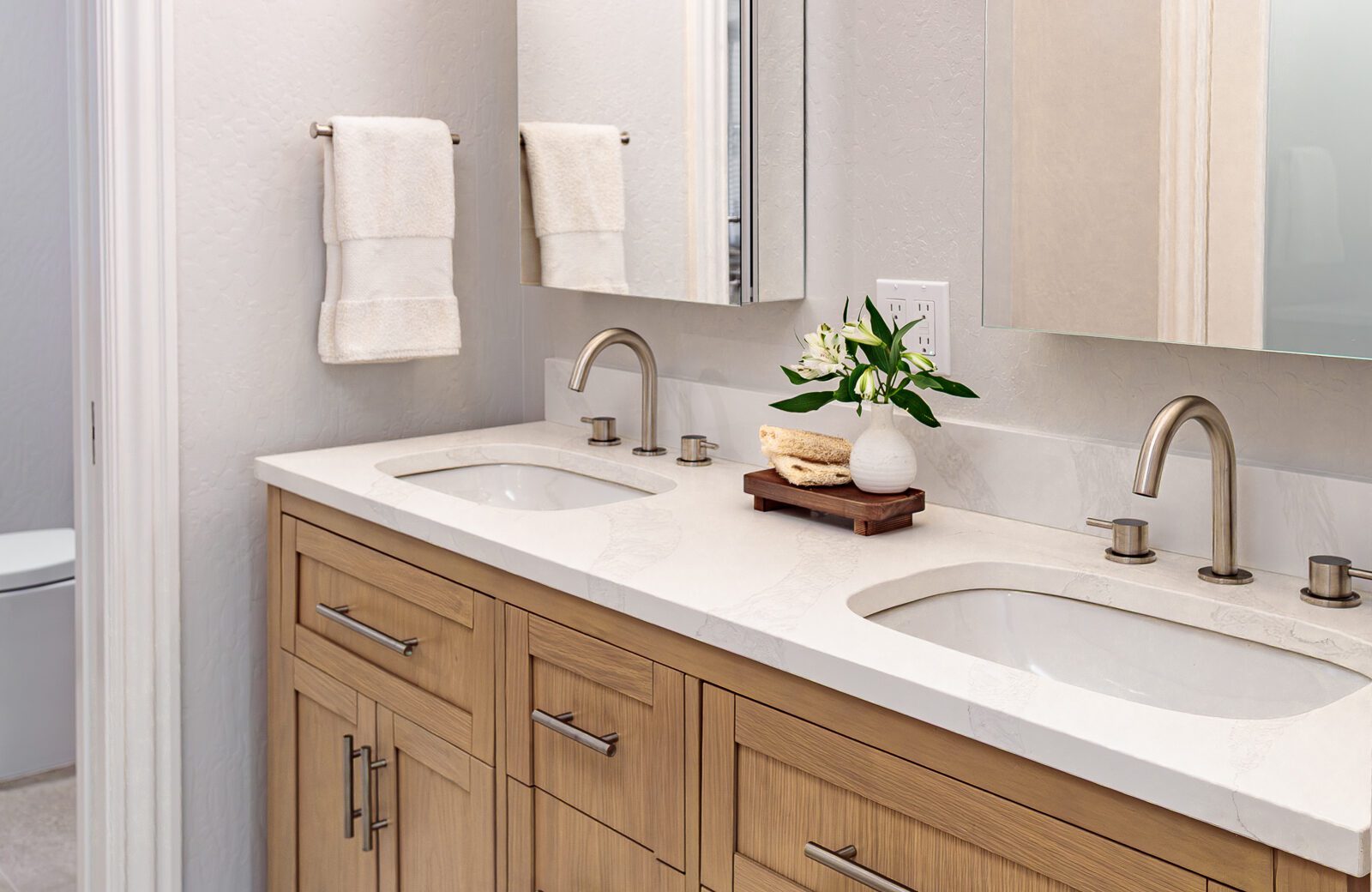
Floating bathroom vanities, also called wall-mounted vanities, create a very different look and experience than standard vanities. By lifting the cabinet off the floor, they change how the bathroom feels, how the storage works, and how the plumbing must be handled. Floating vanities offer clear advantages in many bathroom remodels, but also have constraints that homeowners need to understand early in the design process.
Where Floating Bathroom Vanities Shine
Floating vanities make bathrooms feel larger
A floating vanity leaves the floor visible, which helps the room feel more open even though the square footage stays the same. When the tile continues under the cabinet, the eye reads a larger footprint. This visual expansion makes a noticeable difference in:
- Narrow or small primary bathrooms
- Long or narrow kids bathrooms and hall bathrooms
- Small powder rooms where visual space matters
This sense of openness is a major reason floating vanities are popular in modern bathroom design.
Floating cabinet storage is efficient
Floating vanities do not extend to the floor, so the cabinet box is smaller than a standard vanity. However, their storage is usually better designed. Many floating vanities use drawers built around the plumbing, creating organized compartments rather than a single large open cavity.
This efficient layout and use of space make the storage feel as big as, and sometimes better than, the larger but less structured space inside many standard vanities.
Cleaning under floating vanities is easier
Because the vanity does not touch the floor, it eliminates common problem areas that collect dust or water around the base of a standard vanity. A mop, broom, or vacuum can reach the entire floor area under the cabinet without bumping the finish, which keeps the vanity looking newer over time.
Height flexibility with mounting floating vanities improves comfort
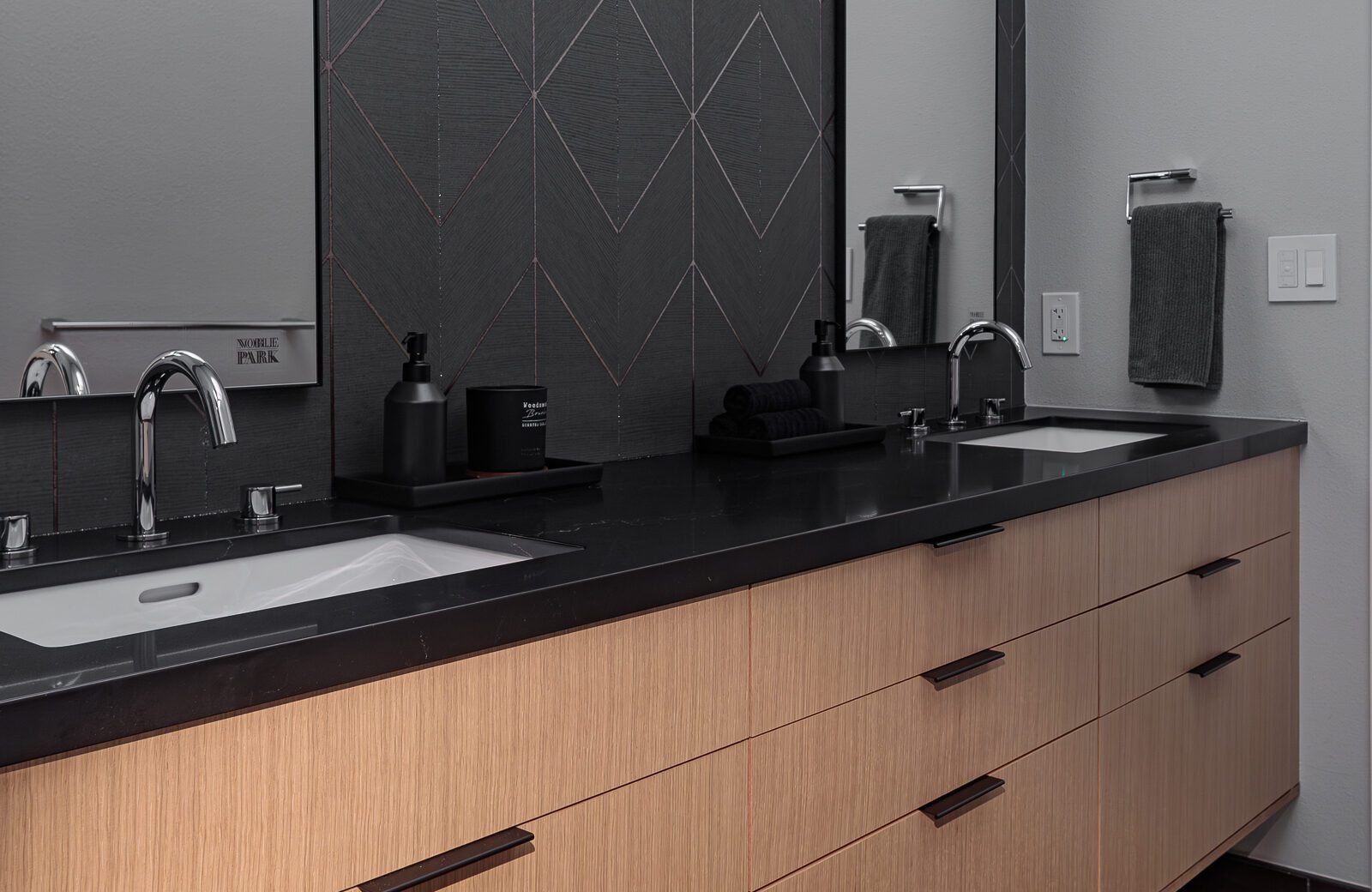
Floating vanities can be mounted at a height that aligns with the users’ comfort. Sink height affects posture, reach, and how easy it is to wash hands or face without bending or stretching. This is especially useful in remodels where the household includes people of different ages or heights.
- In kids’ bathrooms, the vanity can be set slightly lower for easier access. This could be a great idea if your children are small and will benefit from the lower height over a decade or so.
- In primary bathroom remodels, taller homeowners often appreciate a higher sink.
This height customization is not possible with most off-the-shelf standard vanities. The toe kick height, which is typically 4.5 inches, can be lowered slightly. Lowering a toe kick more than an inch or so makes the kick less functional as the kick is really providing toe space for someone standing at the cabinet.
Raising a standard vanity higher would require building an unusually tall toe kick, which looks visually off.
Because of these limitations, floating vanities offer far more flexibility when customizing the sink height.
Lighting opportunities are better with floating vanities
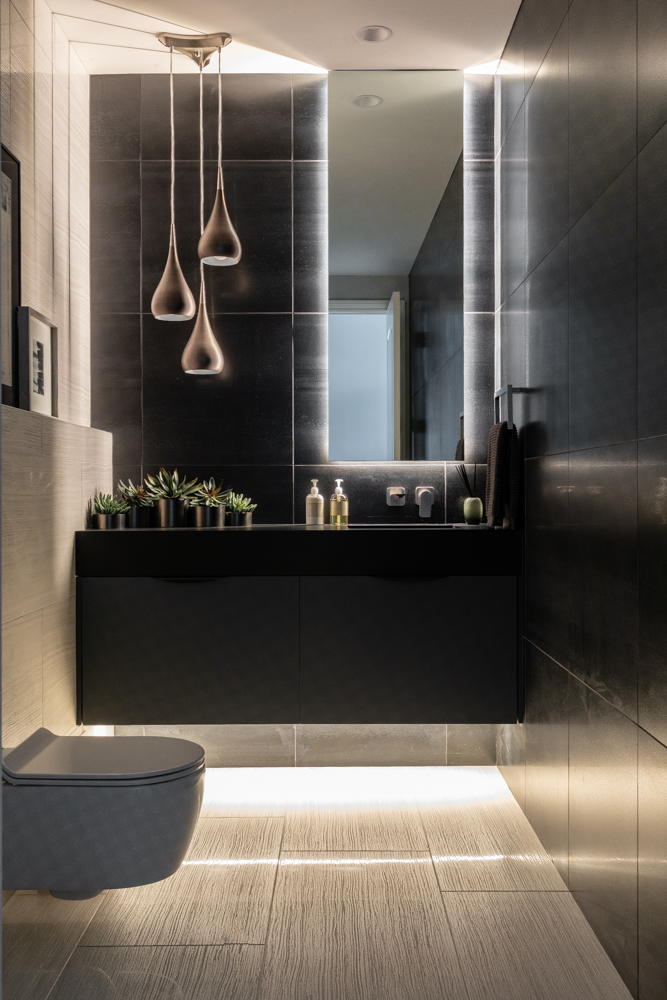
A floating vanity offers lighting effects that are not possible with a standard vanity. Under-cabinet LED lighting creates a soft glow across the floor tile, which can serve as gentle accent lighting during the day or a night light for navigating the bathroom safely after dark. Because the cabinet is mounted higher and the light sits farther back, the effect is more dramatic than lighting placed in the toe kick on a standard vanity. Homeowners who want a spa-like or modern bathroom often appreciate this added design feature.
Where Floating Bathroom Vanities Struggle
They rely on the wall structure
A floating vanity must be mounted to a wall that is strong enough to support the cabinet, countertop, and sink. During a bathroom remodel, you must evaluate the wall framing early because not every wall can easily support a wall-mounted vanity. We do that as part of our design-build process, but you will need to coordinate that for DIY or working with a separate designer and contractor.
A less common but important limitation arises when a pocket door frame is installed inside the wall. The track, hardware, and door occupy the exact space required for plumbing and reinforcement, making it impossible for the wall to support the weight of a floating vanity and to plumb a vanity sink. When this comes up, we evaluate whether the vanity can be moved to a different wall with the proper structure, whether we can make the wall thicker to allow for plumbing and structural support, or whether a standard vanity plumbed through the floor is the better and simpler choice for that location.
Plumbing must be high enough
Floating vanities require the plumbing to be high enough to sit inside the cabinet. If the drain or supply lines are too low, they will be visible beneath the vanity, defeating the purpose of choosing a floating design. Homes with plumbing that comes from the floor or sits too low often need those lines moved into the wall to make a floating vanity possible.
Limited compatibility with traditional or craftsman bathroom designs
Floating bathroom vanities work best in modern, contemporary, or spa-like bathroom remodels. Their clean lines and minimal form create a lighter, more architectural look that fits these styles well.
In homes with traditional, craftsman, or very detailed millwork, a floating vanity can feel out of place because it lacks the visual weight or furniture-like character those styles rely on. In these cases, a standard vanity usually aligns better with the rest of the home’s design and proportions.
When a Floating Vanity Is the Right Fit
Floating bathroom vanities are a strong option when:
- The bathroom remodel leans modern, contemporary, or spa-like
- The room is small and benefits from visual openness
- The plumbing is already in the wall versus the floor
- Height flexibility will improve everyday comfort
- Cleaning efficiency is a priority
- Other storage options, such as medicine cabinets or a linen tower, are part of the bathroom design
Floating vanities offer a clean look that can help your remodeled bathroom feel more open. When the structure and plumbing allow it, they can elevate both the style and the function of a bathroom remodel.
Installation Requirements for Standard and Floating Bathroom Vanities
Choosing between a standard vanity and a floating vanity is partly a style decision and partly a construction decision. Each type has different support needs, plumbing requirements, and interactions with the existing tile and layout. Understanding these factors early helps prevent surprises during a bathroom remodel.
How Standard Bathroom Vanities Are Supported
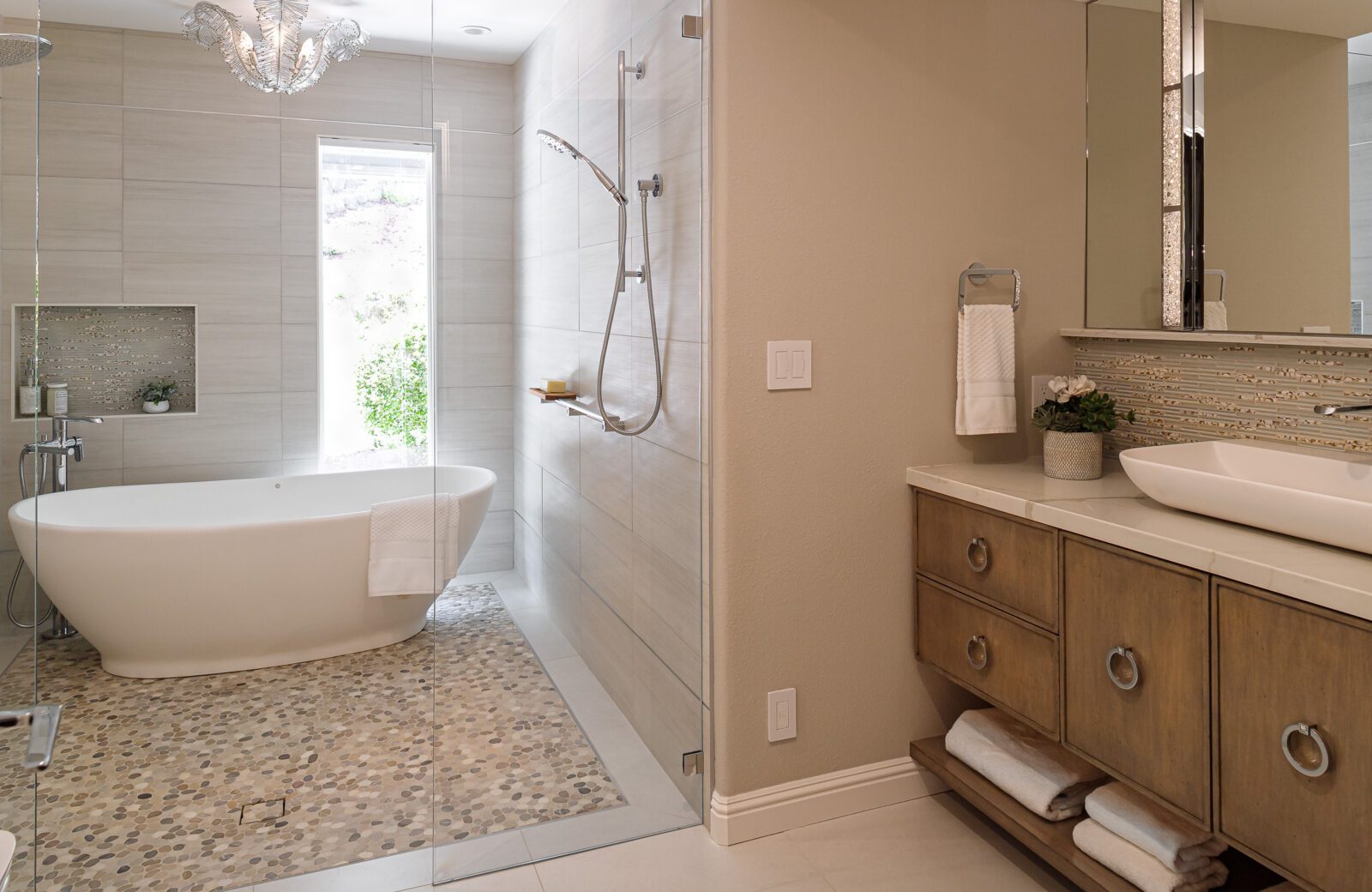
A standard vanity rests on the floor, so the floor structure carries the weight of the cabinet, countertop, and sink. The wall attachment simply keeps the cabinet stable and prevents tipping. Because the plumbing stays inside the vanity, the plumber typically has more flexibility with trap height and pipe placement. When you replace one standard vanity with another of similar size, the existing rough plumbing and floor tile often stay intact with minimal disruption.
How Floating Bathroom Vanities Are Supported
Floating vanities, or wall-mounted bathroom vanities, rely entirely on the wall framing for support. Since nothing touches the floor, all the weight must be transferred into the studs. The wall may need to be reinforced before installation by either adding solid wood blocking between studs or installing a metal support that ties into the framing.
Floating vanities also require the plumbing to be located inside the cabinet. If the drain or supply lines come from the floor or sit too low, they must be raised and/or moved into the wall. If the plumbing needs to be moved, this will affect your budget.
How Existing Tile Affects Your Bathroom Vanity Options
The most common scenario: no tile under the old vanity
In many bathroom remodels, the original standard vanity was installed on the subfloor, and the tile was laid around it. When the vanity is removed, the exposed subfloor becomes visible.
If you pick a floating vanity, that unfinished area becomes visible beneath the cabinet, which means the floor needs to be either repaired or more often replaced. Matching existing tile is rarely practical because older tile is often discontinued or varies in shade. Matching the grout may be problematic as well.
Because most of our homeowners are doing full bathroom remodels or updating multiple rooms in the house, many already plan to retile the entire bathroom. For them, switching to a floating vanity is easier to accommodate. For others, there are two realistic options:
- Replace the entire bathroom floor.
- Choose a new standard vanity with the same footprint so the unfinished area stays concealed.
The less common scenario: tile under the old vanity
Occasionally, tile continues under the existing vanity. While this solves the visibility issue for floating vanities, it can introduce a different installation challenge.
If the new standard vanity is not the same size, any exposed grout joints will vary in color from the rest of the floor.
Any toe kick will need to be scribed to the floor, or there will be gaps at the grout joints and at tile inconsistencies. The baseboard will need to be either cut shorter or extended.
Why tile matters in a bathroom remodel
Tile placement influences how easily a bathroom can transition from a standard vanity to a floating vanity or change cabinet sizes. Be sure to check what you have early in the process so you understand the implications for cost, scope, and feasibility before deciding on a vanity style.
Maintenance and Cleaning in a Bathroom Remodel: What Standard and Floating Vanities Are Like in Real Life
How standard bathroom vanities hold up over time
Anywhere a standard vanity touches the floor is a wear point. In real bathrooms, not showroom conditions, the base takes the most abuse. Over time:
- Toe kicks get bumped by mops, brooms, and feet.
- Corners can swell if water sits along the base.
- Furniture-style legs create tight spaces that are difficult to clean around.
- Bathrooms have water and water is hard on most cabinetry finishes.
In busy homes or kids’ bathrooms, splashes around the sink and tub often end up on the floor, and that moisture can collect at the base of a standard vanity. We often remind homeowners that standard vanities simply require a little more attention to drying and cleaning near the floor to keep the cabinet looking good.
How floating bathroom vanities hold up over time
Floating vanities avoid most issues associated with floor contact because the cabinet is entirely lifted off the ground. Cleaning is straightforward. You can run a mop or vacuum right underneath without having to work around legs or toe kicks. None of the cabinet base is exposed to water, kids’ splashes, or daily cleaning tools.
The wall beneath and behind a floating vanity is part of the finished look, so it must be finished. It could be tiled, or painted, and the baseboard may need to be added or cleaned. When this is handled properly, the long-term maintenance is simple.
We have had clients tell us that one of their favorite unexpected benefits of a floating vanity was how easy it made day-to-day cleaning. It seems like a small detail when you are planning a bathroom remodel, but once you live with it, the difference is noticeable.
Pros and Cons of Standard Bathroom Vanities and Floating Bathroom Vanities in a Primary Bathroom Remodel
Pros of a standard bathroom vanity in a primary bathroom remodel
- Creates visual balance across from a freestanding tub or large shower.
- Usually works well with existing plumbing without major relocation.
- Future replacements are simpler because the floor and walls remain undisturbed.
- Installation requires less structural planning because the floor carries the weight versus the wall.
- Plumbing height inside the cabinet is flexible, which helps in older homes.
Cons of a standard bathroom vanity in a primary bathroom remodel
- Can feel visually heavy in a smaller primary bathroom
- Harder to achieve a modern or contemporary bathroom design
- Base areas see more wear from mops, water, and foot traffic
- Changing cabinet size or switching to a floating vanity later is difficult if the tile does not continue underneath the standard vanity.
Pros of a floating bathroom vanity in a primary bathroom remodel
- Creates a modern, open, spa-like atmosphere
- Makes the bathroom floor feel continuous, helping the room feel larger
- Can be mounted at a height that suits the homeowners’ comfort
- Under-cabinet lighting enhances the design and highlights tile finishes in a way that is not possible with a standard vanity
- Future vanity swaps are easier because the finished floor continues underneath
- Storage is generally more efficient and easier to organize because floating vanity designers typically have more thought put into the storage.
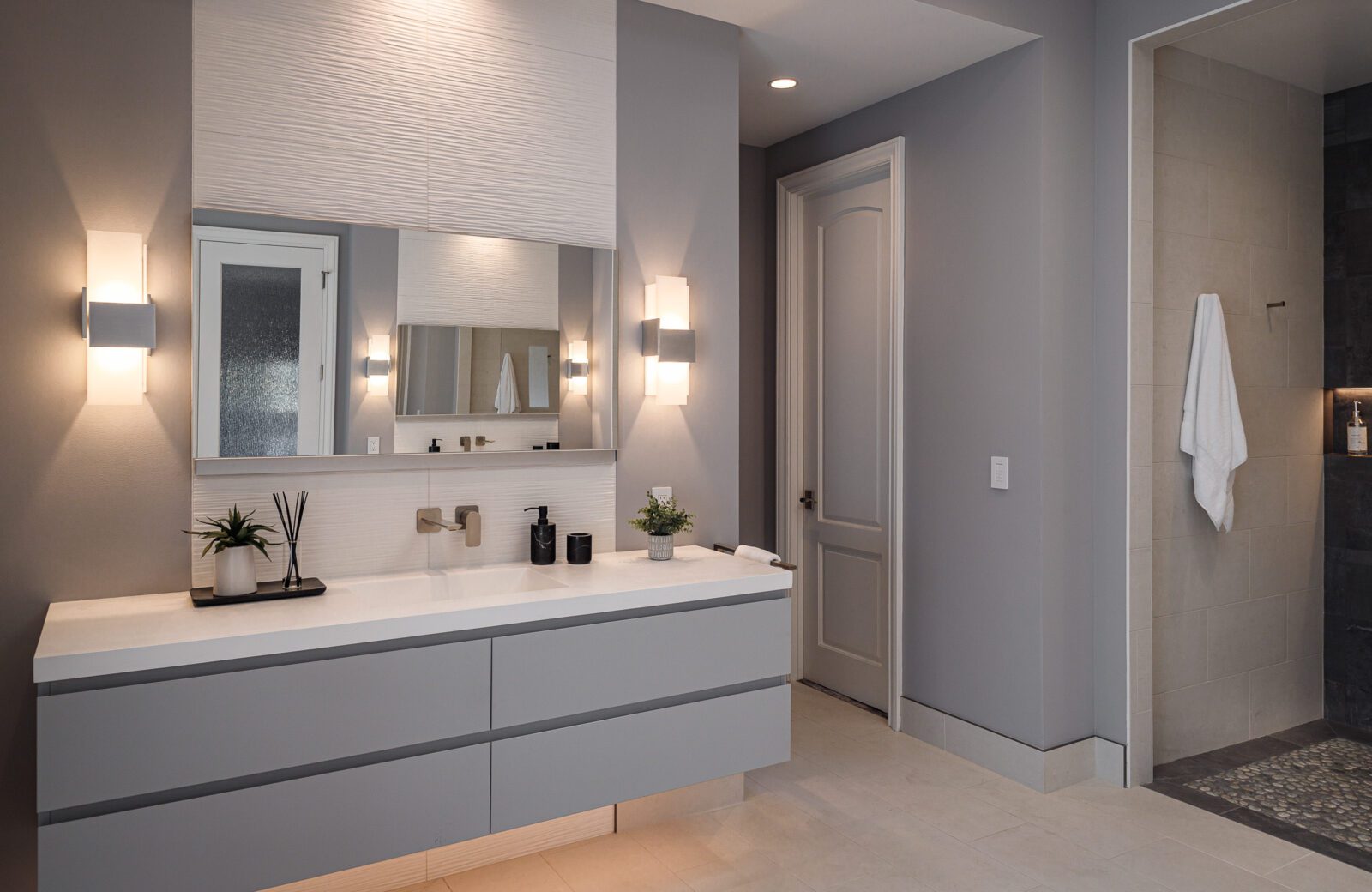
Cons of a floating bathroom vanity in a primary bathroom remodel
- May require reinforced wall framing with blocking or metal support, which takes time and expense to plan for and to install.
- Plumbing must be in the wall rather than coming up from the floor.
- Supports and fasteners must be rated for the total weight of the cabinet and countertop
- When the storage is being optimized, it may require plumbing in a particular spot within the cabinet.
Pros and Cons of Standard Bathroom Vanities and Floating Bathroom Vanities in a Hall Bathroom or Kids Bathroom Remodel
Pros of a standard bathroom vanity in a hall bathroom or kids bathroom remodel
- Familiar, durable, and easy to replace with another standard cabinet
- Likely works well with existing plumbing, floor-based or otherwise
- Lower installation cost
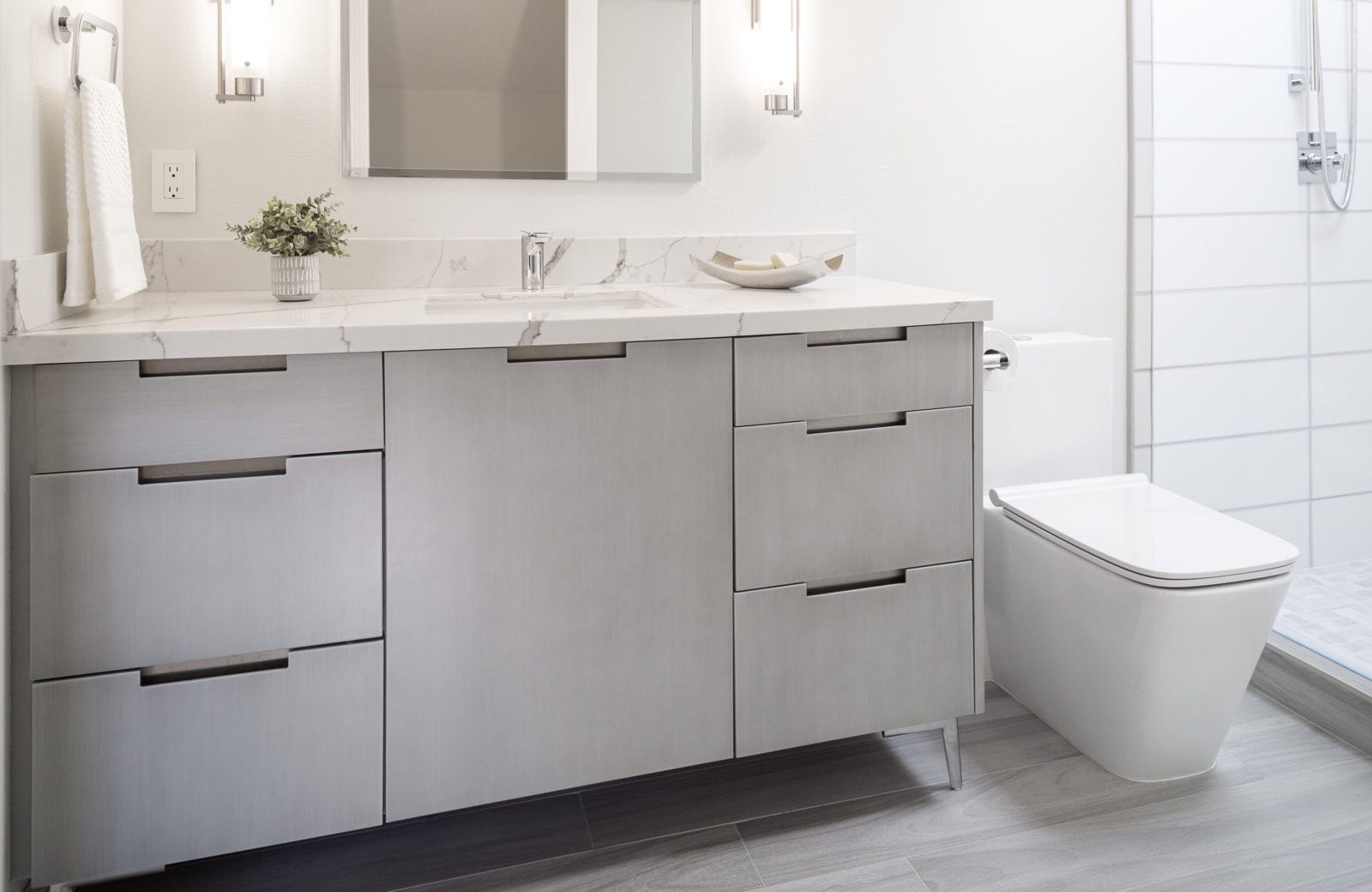
Cons of a standard bathroom vanity in a hall bathroom or kids bathroom remodel
- Toe kicks and base edges take wear from kicking, scooters (we’ve seen this!), and daily traffic.
- Bath time water may collect at the base and can damage finishes.
- Cleaning around the base is more time-consuming in a room that already sees extra mess.
Pros of a floating bathroom vanity in a hall bathroom or kids bathroom remodel
- No toe kick to damage because the cabinet does not touch the floor.
- Makes it easier to mop up water after bath time.
- Step stools can slide under the vanity instead of blocking doors and drawers depending on the height you choose for the vanity.
- Can be mounted slightly lower for young children.
- Helps a narrow hall bathroom feel more open.
- Kids love to crawl under them, which can be a fun, real-life family moment (or a teeth brushing procrastination!).
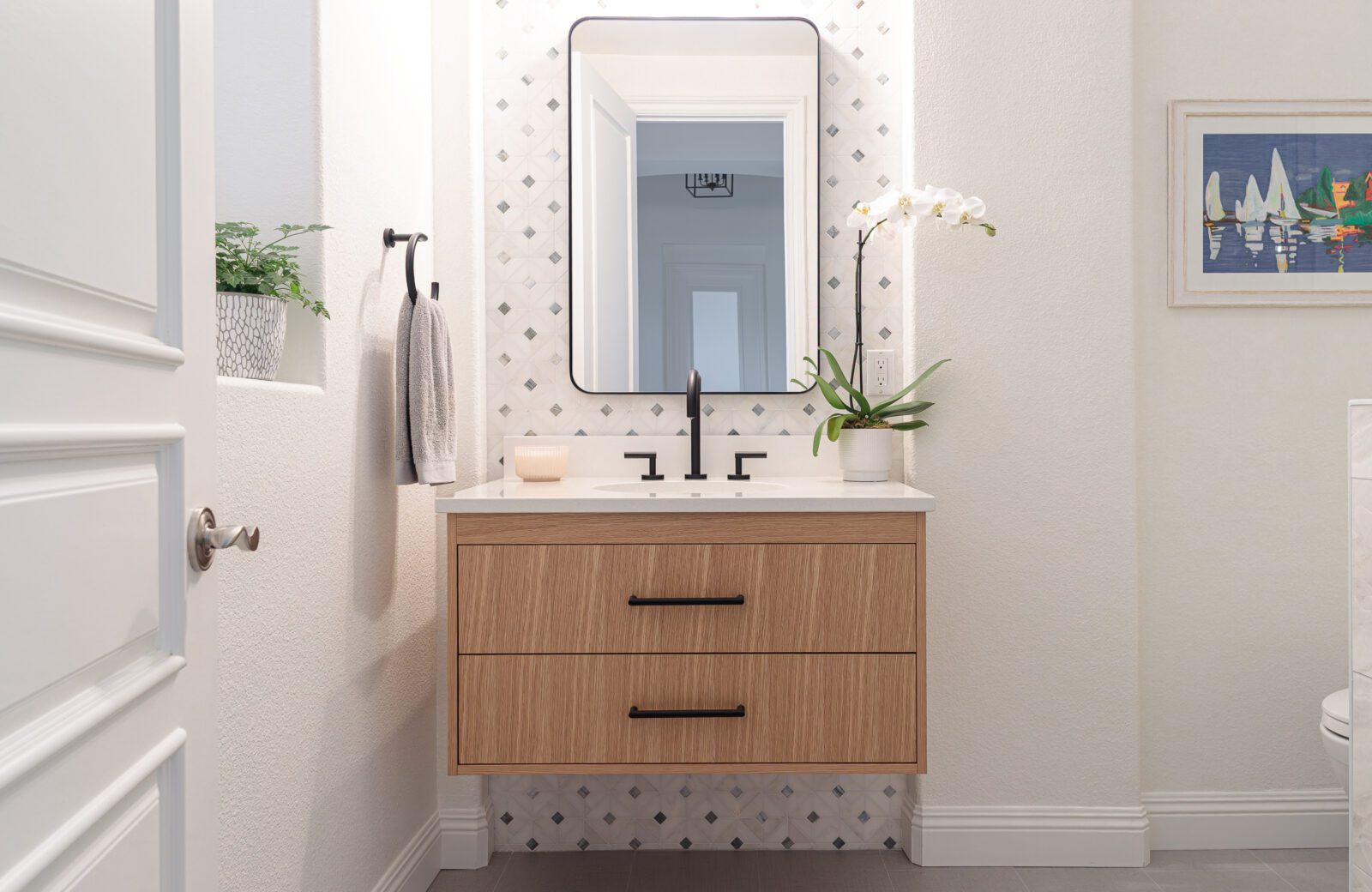
Cons of a floating bathroom vanity in a hall bathroom or kids bathroom remodel
- Additional budget might be needed on structural work, flooring, plumbing relocation, and some families don’t allocate as much budget to kids’ bathrooms because they can be very hard on things!
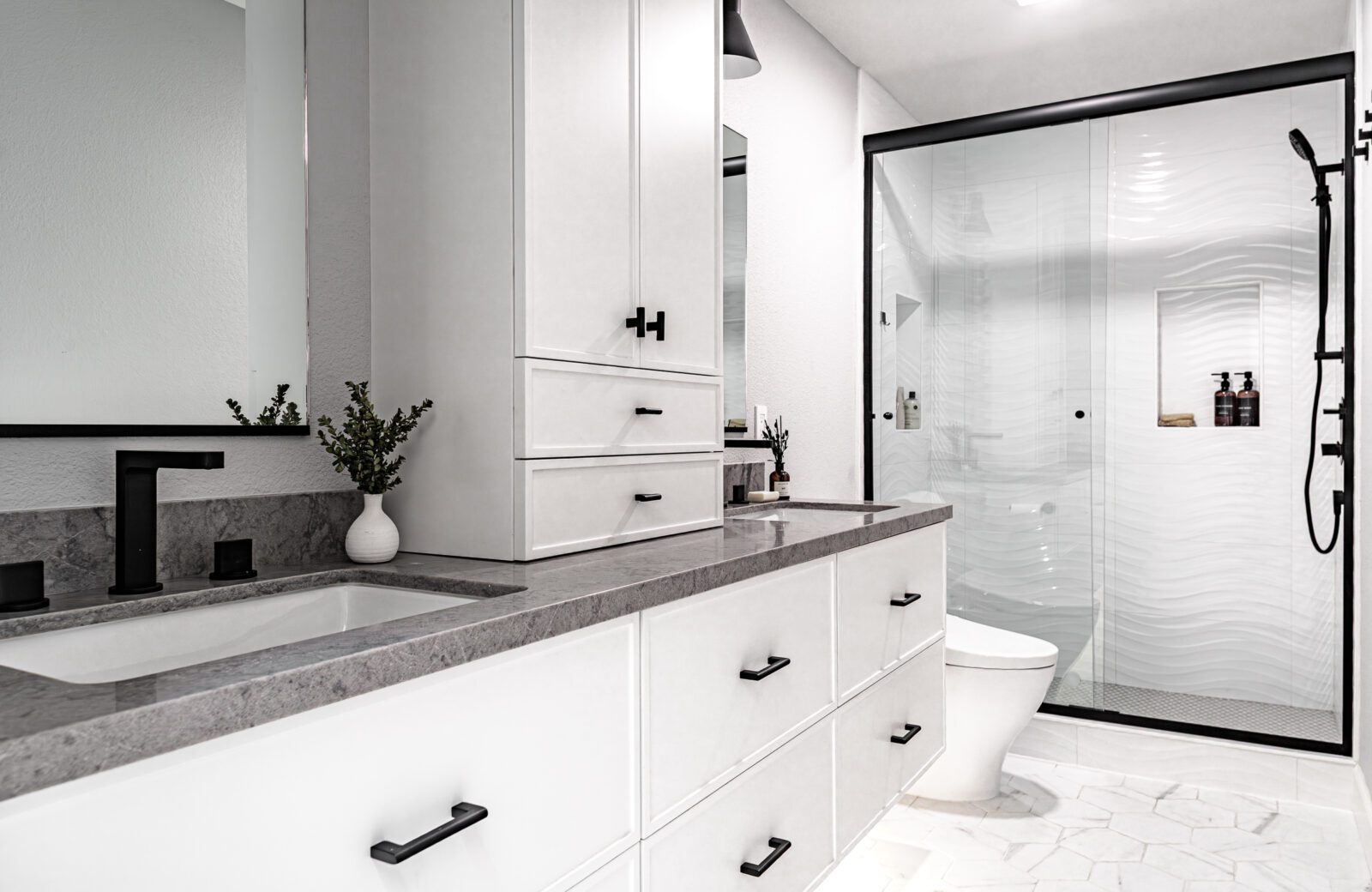
Pros and Cons of Standard Bathroom Vanities and Floating Bathroom Vanities in a Powder Room or Half Bathroom Remodel
Pros of a standard bathroom vanity in a powder room or half bathroom remodel
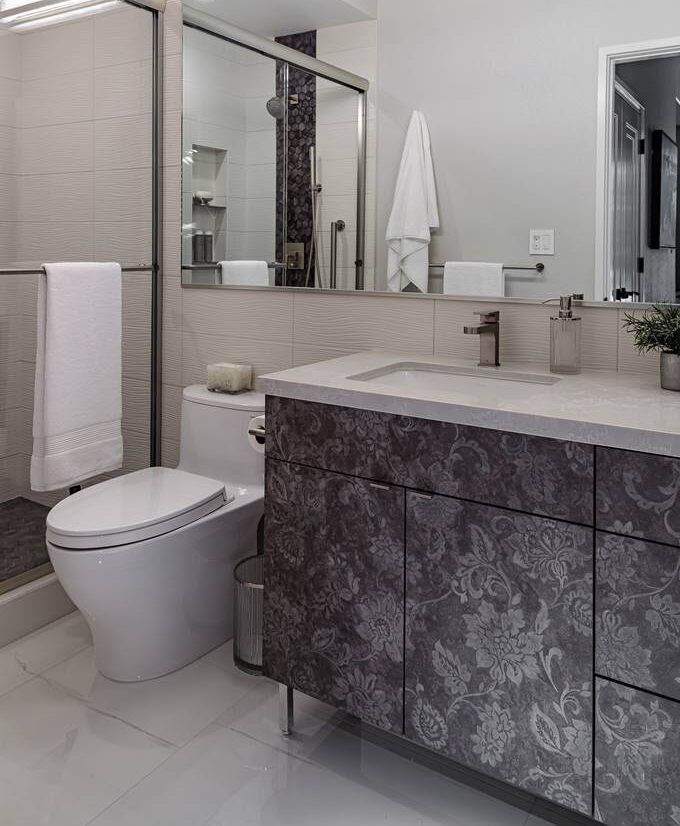
- Furniture style standard vanities add character and create a strong focal point.
- Likely easier to connect to existing plumbing, floor-based or otherwise.
Cons of a standard bathroom vanity in a powder room or half bathroom remodel
- Can visually crowd a small powder room because it takes up more floor space, making a tight room feel even smaller.
- Has inefficient storage with doors unless you choose a custom standing vanity with drawers.
Pros of a floating bathroom vanity in a powder room or half bathroom remodel
- Opens the floor and makes a small powder room feel large
- Shows off decorative floor tile and wall finishes
- Creates a clean, modern impression for guests
- Easy to clean beneath the vanity in tight spaces
- Most efficient use of small storage space because floating vanities often use drawers built with efficiency in mind

Cons of a floating bathroom vanity in a powder room or half bathroom remodel
- Requires blocking or framing adjustments that can be more involved in older homes
- May not align well with very traditional architecture unless the rest of the design bridges the style
- The exposed floor and wall beneath the vanity must be finished cleanly because it remains visible
Standard Bathroom Vanity vs Floating Bathroom Vanity: Feature Comparison
Here is a side-by-side comparison of standard versus floating vanities for features our clients ask about most.
| Feature | Standard Bathroom Vanity | Floating Bathroom Vanity |
|---|---|---|
| Design style | Works well in traditional and transitional bathroom designs; creates a grounded, furniture-like presence | Best for modern, minimalist, and spa-like bathroom remodels; visually lighter |
| Storage function | Offers the most cabinet volume, but interior space is often inefficient unless customized or paired with organizers | Less total volume but more efficient internal layout, since drawers are designed around plumbing; storage often feels equal in everyday use |
| Installation complexity | Straightforward because the floor carries the load; wall attachment prevents tipping | Requires blocking or metal support in the wall; structure must support cabinet, countertop, and sink |
| Bathroom visual impact | Takes up more visual space; can feel heavy in small bathrooms | Shows more floor tile; makes small bathrooms, narrow bathrooms, and powder rooms feel larger |
| Plumbing compatibility | Works with wall or floor plumbing with little to no modification needed for most homeowners | Requires plumbing to be fully in the wall, set high enough to stay hidden, and located more precisely |
| Cleaning and maintenance | Base, legs, and toe kicks take wear from mops, water, and daily traffic | Easy to clean under; no base or toe kick to collect moisture or debris |
| Height flexibility | Comes at fixed heights unless fully custom | Can be easily mounted higher or lower depending on users (kids bathroom, tall homeowners) |
| Cost considerations | Lower installation cost and likely lower overall cost unless you go fully custom. | More labor and planning costs because of wall support and plumbing adjustments |
Quick Guide: Choosing Between a Standard Vanity and a Floating Vanity
| Preference or Condition | Best Bathroom Vanity Choice |
|---|---|
| Modern, minimalist, or spa-like bathroom design | Floating vanity |
| Traditional, craftsman, or transitional home style | Standard vanity |
| Small or narrow bathroom that needs to feel more open | Floating vanity, because more floor is visible |
| Lower installation cost and simpler replacement in the future | Standard vanity |
| Existing floor plumbing that you do not want to move | Standard vanity |
| Need for adjustable or customized height | Floating vanity or full custom standard vanity |
| Bathroom with finished tile under the entire footprint | Either vanity type works well |
| Bathroom with tile only around the old cabinet footprint | Standard vanity in the same footprint, unless a retile is planned |
| Desire for dramatic under-cabinet lighting | Floating vanity |
| Families who need easy cleaning around the vanity base | Floating vanity |
| Clients who want maximum efficiency from custom drawers and organizers | Either style, depending on design, but floating often offers better internal organization |
Frequently Asked Questions About Standard Bathroom Vanities and Floating Bathroom Vanities
What is the difference between a standard vanity and a floating vanity?
A standard bathroom vanity rests on the floor and is attached to the wall for stability. A floating bathroom vanity mounts only to the wall, leaving the floor visible beneath. This difference affects how the bathroom feels, how the room is cleaned, and how the plumbing and wall structure need to be planned during a bathroom remodel.
What are the disadvantages of a floating bathroom vanity?
Floating vanities need stronger construction and reinforced wall framing. The plumbing must come from the wall instead of the floor. They typically offer less total cabinet volume because the box does not extend to the floor, although the storage is often better organized with drawers built around the plumbing. If the wall framing is not suitable, extra work may be required to make the installation safe.
Does a floating vanity make a bathroom look bigger?
Yes. Because you can see more of the floor tile, the bathroom reads as larger and more open. This is especially noticeable in narrow primary bathrooms, kids’ bathrooms, hall bathrooms, and small powder rooms.
Why are floating bathroom vanities popular?
Floating vanities support the trend towards modern, calm, spa-like bathroom design. They show more of the floor tile, allow for under-cabinet lighting, and make cleaning easier. Many homeowners choose a single floating vanity in the home because it changes the entire room’s feel.
What materials are used for bathroom vanities?
Most bathroom vanities are built from a combination of plywood, MDF, and hardwood for doors or drawer faces. Floating vanities typically rely more on plywood boxes because they need stronger, more rigid construction. Countertops are most commonly quartz. In some cases, MSK specifies integrated fireclay sinks from plumbing suppliers. Undermount sinks are usually ceramic or fireclay.
What sizes are available for bathroom vanities?
Standard widths generally range from 24 inches up to 72 inches or more. While you can technically find smaller units, anything around 18 inches wide leads to a very small sink. For most single-sink bathrooms, 30 to 48 inches is a comfortable range. For double sinks, we recommend at least 60 inches; 72 inches is better, since each sink is about 19 inches wide and you still need room for drawers.
Depth is usually around 21 inches. Once you move down to 18 inches, there is not enough space behind the sink for a deck-mounted faucet, so a wall-mounted faucet is typically required.
What is the most popular size for bathroom vanities?
For single sink bathrooms, 36 inches is a flexible, commonly requested size. For primary bathrooms with two sinks, 60 or 72 inches is typical, with 72 inches offering the most comfortable spacing.
How much should you pay for a bathroom vanity?
Pricing varies based on whether the vanity is stock, semi-custom, or fully custom, as well as the countertop and hardware selections. In design meetings, MSK reviews a budget for the entire bathroom remodel and then allocates an appropriate share to the vanity, countertop, and plumbing fixtures, rather than isolating the vanity cost.
Does a bathroom vanity need to be attached to a wall?
Yes. Both standard and floating vanities are attached to the wall. For standard vanities, the attachment prevents tipping and locks the vanity in place. For floating vanities, the wall attachment is the primary structural support.
Does a bathroom vanity need to be flush with the wall or the side wall?
The back of the vanity should be flush with the wall so plumbing connections are clean and there are no gaps that collect debris. On the side, very small gaps tend to create cleaning issues. Either keep the vanity tight to the wall or leave enough room to reach beside it for cleaning.
Does a bathroom vanity need a backsplash?
In almost every bathroom remodel, yes. A backsplash protects the wall from water and reduces maintenance. Many homeowners choose a three- to four-inch backsplash in the same material as the countertop or continue tile up the wall behind the sink.
Does a standard bathroom vanity go on top of tile?
No. In most remodels, a standard vanity is installed on the subfloor, and the tile is laid around it. This is the typical approach and gives a nice, clean finished look. Floating vanities require fully tiled or finished floors because the flooring will be visible beneath them.
Why is it called a vanity?
The term comes from early dressing tables used for grooming. When sinks and storage were combined into a single bathroom fixture, the name carried over and became standard in bathroom design.
When should you choose a bathroom standard vanity?
MSK often recommends a standard vanity when the home is more traditional, the homeowners want a grounded, furniture-like look, the existing plumbing or tile conditions make floating less practical, or when the bathroom remodel budget is better used elsewhere in the space.
What if my powder room is so small that my standard or floating vanity won’t be the standard 21” deep?
Depth is an important consideration for both standard bathroom vanities and floating bathroom vanities. Most bathroom vanities are around 21 inches deep. Shallower options around 18 inches are possible, but they compress the space between the front of the sink and the back of the counter.
At 18 inches deep, there is usually not enough room for a deck-mounted faucet behind the sink. In these cases, MSK almost always specifies a wall-mounted faucet for proper clearance. This applies to both standard and floating vanities. It is not a style issue. It is simply a matter of comfort and physics.